

THE VISUAL ARCHITECTURE COMPANION
Your sparring partner for the work ahead.
What to Expect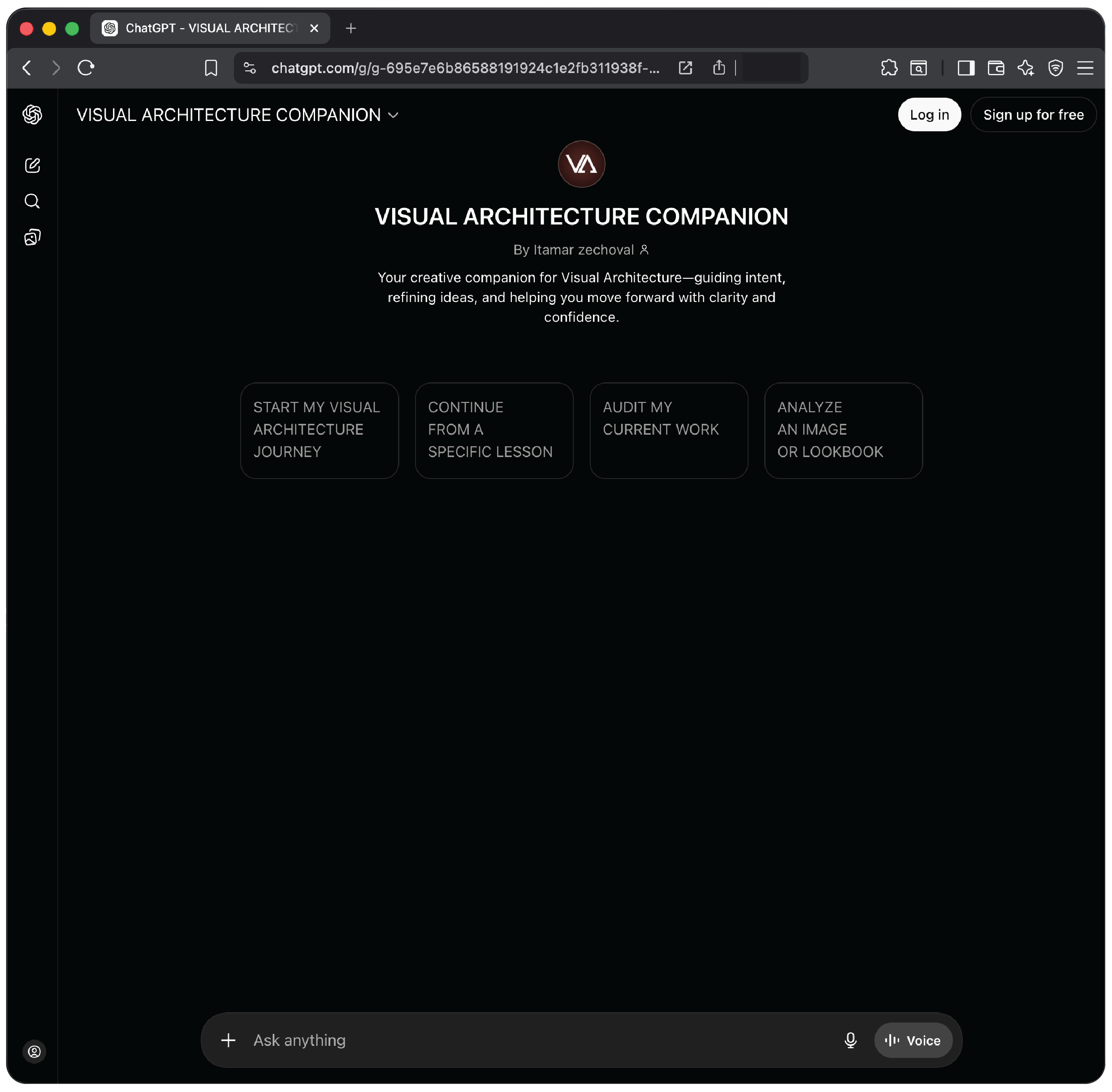
The Companion is a custom-trained assistant built on the Visual Architecture methodology.
It thinks the way the course teaches, in systems, decisions, & architecture.
Use it beside you as you build through the lessons.
Four modes, one assistantThe Companion shifts modes based on how you ask:
Guide Mode — Default. Warm, supportive, forward-moving. For thinking out loud as you work through a lesson.
Sparring Mode — Tougher. Names contradictions, pushes back on vague definitions. For when you want your thinking stress-tested. Try: "Push back on this."
Execution Mode — Translation. Turns your defined decisions into structured prompts for any AI tool. Try: "Help me assemble this into a Midjourney prompt."
Analysis Mode — Diagnostic. Upload an image, lookbook, visual pack, or character sheet, and the Companion will check it against your defined rules or reverse-engineer it through the course framework.
What to ask itThe Companion is most useful when you bring work in progress rather than open questions:
"I'm on Lesson 2. My Character ID Card feels vague, can you check it?"
"Here's my Intent Map. What's missing?"
"My world rules and character architecture contradict each other. Help me see where."
"Translate this character definition into an execution prompt."
"Read this lookbook and tell me what's drifting."
What it will not doIt will not make aesthetic decisions for you — palettes, materials, styles, compositions. That work stays yours.
It will not invent course content. If you ask about something specific in a workbook, it will point you back to the workbook.
It will not call any prompt "final," "optimized," or "correct."
This is intentional. The course teaches you to be the author. The Companion exists to sharpen your thinking, not replace it.
Getting the most out of itBe specific. "Help me with style" gets a vague answer. "I've defined three materials but they pull against each other" gets a real audit.
Bring work. Definitions, sketches, intent maps, images - the Companion does its best work when there's something concrete to react to.
Use Sparring Mode early. Better to find a contradiction at Lesson 2 than at Lesson 7.
Don't ask it to choose for you. Ask it to help you find your own decision.